 Trang Chủ


Operational Mechanism of a Deposit Insurance Organization – International Practices
In most countries worldwide, deposit insurance (DI) membership is compulsory; under this framework, legal provisions require institutions that mobilize public deposits to be members of the deposit insurance system and to pay DI premiums. To operate this system, countries establish DIOs. The names of these organizations may vary across countries, such as: Deposit Insurance Corporation (USA, Japan, South Korea, Taiwan...); Deposit Protection Fund (Brazil, Bulgaria, Czech Republic, Laos...); Deposit Insurance Agency (Croatia, Thailand…). However, DIOs generally share common characteristics: they are public- policy institutions (distinct from conventional insurance companies); they operate on a non-profit basis to protect depositors and contribute to the stable development of the banking system; and they are governed by a transparent governance mechanism (Board of Directors, Executive/ Management Board, and Controllers /Audit Board).
The operational activities of DIOs are closely linked to the life cycle of insured institutions, for example:
When an insured institution is established, the regulatory authority reviews and grants it an operating license. At the same time, the DIO issues a Certificate of Deposit Insurance Participation.
During the operation of insured institutions, the DIO collects premiums to build and develop the DI Fund. Furthermore, in many countries, DIOs are authorized to examine and supervise the activities of insured institutions. The rationale is: i) Effective oversight by the DIO enables the early detection of weak institutions so that regulatory authorities can implement timely interventions to prevent bank failures, thereby reducing the likelihood of using the DI fund for payout; ii) The scale and complexity of banking activities have grown significantly, while the resources of supervisory authorities (the central bank, supervisory commissions...) are limited. The DIO, therefore, serves as a supplementary policy tool to help ensure systemic safety.
When an insured institution is is identified as financially distressed, DIOs in many countries are empowered to engage in early intervention and resolution efforts to prevent failures, thereby minimizing negative impacts on depositors.
In the event an insured institution becomes insolvent and unable to repay depositors, the DIO uses its DI fund to reimburse depositors.
A fundamental principle of market economies is to minimize the use of public funds to resolve ailing banks. Furthermore, after experiencing isolated bank failures or banking crises, countries have increasingly recognized the importance of establishing DIOs, granting them appropriate powers, and building sufficiently large DI funds to serve as additional policy tools for addressing bank distress. Therefore, after each banking crisis, the number of DIOs established tends to rise.
The U.S. Federal Deposit Insurance Corporation (FDIC), the first DIO in the world, was founded during the Great Depression (1929–1933). The 1997 Asian financial crisis prompted the creation of many DIOs, such as the Deposit Insurance of Vietnam (1999), the Lao Deposit Protection Fund (1999), the Indonesia Deposit Insurance Corporation (2004) and the Malaysia Deposit Insurance Corporation (2005), etc. The 2007–2008 global financial crisis further underscored the importance of deposit insurance systems, leading to the establishment of many new entities, including the Thailand Deposit Protection Agency (2008) and the Deposit Compensation Agency of Belarus (2008), etc. As of August 2025, there were 130 DIOs worldwide, 107 of which are members of the International Association of Deposit Insurers (IADI).
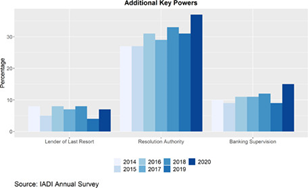
Along with the increase in numbers, there is a global trend toward granting expanded mandates to DIOs. According to the IADI report “Deposit Insurance 2024 – Global Trends and Key Issues”, the proportion of DIOs endowed with additional powers (such as supervision, inspection/ examination, early intervention, resolution) increased from 75% to 83% between 2014 and 2023. This trend reflects countries’ positive assessment of DIOs’ role in the banking system.
Maintaining the Operational Model of a Non-Profit State Financial Institution in Vietnam
In Vietnam, the Deposit Insurance of Vietnam (DIV) was established under the Prime Minister Decision No. 218/1999/QĐ-TTg dated November 9, 1999, with an initial charter capital of VND 1,000 billion provided by the state budget.
Under current laws, the DIV is a state financial institution operating on a non-profit basis, tasked with protecting the legitimate rights and interests of depositors and implementing the deposit insurance policy to contribute to the stability of credit institutions and the safe and sound development of the banking sector. The DIV’s revenues are exempt from taxes in accordance with relevant laws.
Under the 2012 Law on Deposit Insurance, DIV’s core operations include:
(i) Issuing and revoking Certificates of DI Participation;
(ii) Calculating and collecting DI premiums;
(iii) Managing, using, and preserving the DI Fund;
(iv) Supervising and examining compliance with DI regulations;
(v) Collecting, analyzing, and processing information on insured institutions;
(vi) Participating in special control of insured institutions;
(vii) Paying deposit insurance to insured depositors;
(viii) Participating in managing and liquidating assets of insured institutions;
(ix) Promoting public awareness on DI policy and regulations.
Under Decision No. 527/QĐ-TTg dated April 1, 2016, amending and supplementing certain articles of its Charter, the DIV is a state financial institution operating as a single-member limited liability company with 100% state-owned charter capital. The State Bank of Vietnam (SBV) shall exercise the rights and obligations of the State owner’s representative for the DIV in accordance with the Law on Deposit Insurance, Decree No. 68/2013/ND-CP dated June 28, 2013 guiding its implementation, and other legal provisions governing the State owner’s representative in single-member limited liability companies with 100% state-owned charter capital. The DIV manages its own labor, salaries, remunerations, bonuses, and wage-related expenses in accordance with regulations applicable to special-class single-member limited liability companies with 100% state-owned charter capital, and guidelines issued by the Ministry of Labor, Invalids, and Social Affairs in alignment with the specifications of the DIV’s activities.
The financial regime for the DIV is set by the Ministry of Finance, in coordination with the SBV, based on the financial mechanism applicable to single-member limited liability companies with 100% state-owned charter capital and on the specific operational characteristics of the DIV.
The 2024 Law on Credit Institutions assigns several additional tasks to DIV, including:
(i) Providing special loans to commercial banks, cooperative banks, people’s credit funds, and microfinance institutions as regulated by the Law on DI;
(ii) Purchasing long-term bonds issued by assuming institutions under compulsory transfer;
(iii) Participating in assessing the feasibility of recovery plans, merger/acquisition plans of people’s credit funds;
(iv) Participating in developing bankruptcy plans for CIs under special control.
After nearly 26 years, the DI system in Vietnam has achieved many significant achievements. As of September 30, 2025, the DIV’s total assets exceeded VND 139 trillion (including the Operational Reserve Fund of VND 132.8 trillion), 139 times higher than its initial charter capital. The DIV currently operates through a headquarters and 8 regional branches nationwide.
According to regulatory authorities, in recent years, the DIV has effectively fulfilled its responsibilities, including issuing DI certificates, collecting premiums, examining and supervising, participating in special control, and reimbursing insured depositors. These achievements form a solid foundation for the DIV to continue performing new tasks under the Law on Deposit Insurance (amended), expected to be approved at the 10th Session of the 15th National Assembly.
To further leverage DIV’s existing resources and optimize the DI instrument, the Draft DI Law (amended) provides that:
“The deposit insurance organization is a state financial institution established and assigned specific functions and duties by the Prime Minister. It is a legal entity operating on a non-profit basis, with financial autonomy and a cost-recovery mechanism. Its governance structure consists of a Board of Directors, Controllers, and a General Director.
The deposit insurance organization has a headquarters, branches, representative offices, and other affiliated units (if any).
The Government shall regulate its organization, operations, salary and remuneration regime, and bonuses in accordance with its operational characteristics.”
Since its establishment in 1999, the DIV has consistently operated as a non-profit state financial institution. This status was already codified in the 2012 Law on Deposit Insurance and continues to be upheld in the Draft Law.
Experts note that maintaining the DIV as a non-profit organization aligns with the fundamental purpose of deposit insurance - protecting depositors and contributing to the safety of the banking system - and with international practices. At the same time, establishing a legal framework for financial autonomy, cost recovery, and a governance structure (Board of Directors, Controllers, General Director) conforms to legislative principles, leaving detailed regulations on organization, operations and compensation policies to the Government’s authority.
Department of Research and International Cooperation (translation)