 Trang Chủ


Toward a flexible deposit insurance premium mechanism for each period
The draft Law on Deposit Insurance (amended) proposes authorizing the Governor of the SBV to stipulate the deposit insurance premium rate and decide whether a flat-rate or differentiated premium system should be applied, depending on the characteristics of the Vietnamese credit institution (CI) system in each period. This revision aims to establish a legal basis for applying a more flexible premium mechanism (flat-rate or differentiated) suitable to the real conditions of the CI system in each period, while delegating deposit insurance premium-setting authority to the Governor of the SBV. Meanwhile, under the current Law on Deposit Insurance, the Prime Minister determines the premium framework, and the SBV sets specific premium rates for insured institutions based on their assessment and classification results.
Experts evaluating the proposed amendments and supplements state that delegating authority to prescribe deposit insurance premiums to the Governor of the SBV is consistent with the Party and State's policy on strengthening decentralization and delegation of authority, and aligns with the functions, powers, and responsibilities of the SBV. As the regulatory body responsible for inspecting and supervising the CI system and overseeing deposit insurance activities, the SBV has a sufficient basis to determine premium rates and whether flat-rate or differentiated premiums are appropriate in any given period.
In addition, the flexible approach – under which the Governor of the SBV prescribes the application of flat-rate or differentiated premiums suitable to the characteristics of the CI system in each period – is based on the following considerations:
First, both the flat-rate and differentiated premium systems have their own advantages and disadvantages; neither system is universally superior. The differentiated premium system (where lower-rated, higher-risk CIs pay higher premiums, and higher-rated, safer CIs pay lower premiums) has the advantage of aligning with market principles, encouraging CIs to enhance governance capacity and operate prudently and safely to benefit from lower premiums. However, its disadvantage is that lower-rated CIs, already facing financial difficulty, would have to pay higher premiums, potentially worsening their situation.
Second, in the context where depositor awareness of deposit insurance policy remains limited, immediate adoption of a differentiated premium system may directly influence depositor behavior; depositors may simultaneously withdraw funds from lower-rated CIs and shift to higher-rated ones (as rating information used for calculating premiums cannot be absolutely confidential). Therefore, transitioning to a differentiated system requires careful assessment based on market realities.
The flat-rate of 0.15% per annum on the average balance of all insured deposits of insured institutions is currently applied in Vietnam. Applying this mechanism is appropriate given the operational status of CIs in Vietnam, which helps the DIV's insurance reserve fund grow steadily and serves as an important financial resource for reimbursement and addressing weak CIs.
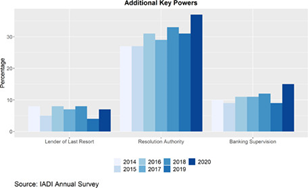
International practice shows that the number of jurisdictions applying flat-rate and differentiated premiums is relatively balanced. According to the 2024 annual survey of the International Association of Deposit Insurers (IADI), among 110 deposit insurers responding to the question on premium systems, 50 (46%) apply flat-rate premiums, 52 (47%) apply differentiated premiums, and 8 (7%) apply a combination of both. This balance reflects countries' careful consideration of the advantages and disadvantages of each system before deciding on the application.
Therefore, the proposal in the draft Law on Deposit Insurance ensures flexibility in applying either flat-rate or differentiated premiums suitable for each period, in line with the characteristics of the Vietnamese CI system.
Increasing deposit insurance premiums to offset special loans from the SBV
The draft Law on Deposit Insurance (amended) proposes that when the deposit insurer obtains a special loan from the SBV, it shall develop a plan to increase deposit insurance premiums to offset the special loan and submit it to the SBV for review and decision.
Simultaneously, the draft Law also proposes provisions on special loans from the SBV as follows: the deposit insurer shall develop a plan to increase premiums to offset the special loan; use repayments of special loans by CIs, proceeds from the sale of securities held by the deposit insurer, proceeds from the liquidation of assets of CIs receiving special loans, and deposit insurance premiums to prioritize repayment of the special loan to the SBV.
This proposal aims to ensure consistency with the provisions of the Law on Credit Institutions 2024. Furthermore, under the draft Law, the Deposit Insurance of Vietnam (DIV) may access special loans from the SBV only when DIV's operational reserve fund is insufficient to reimburse depositors. Accordingly, premium increases would apply solely in exceptional circumstances, providing DIV with a more favorable basis for financial planning and liquidity management, ensuring its reimbursement capacity, and accelerating repayment of the State (SBV) budget.
Experts note that, in principle, banking operations are interconnected and subject to "domino effects"; the failure of one bank may lead to mass withdrawals and pose risks to the safety of other banks (even those operating safely and soundly). Therefore, when the operational reserve fund is insufficient to reimburse depositors on a large scale, healthy banks that remain solvent have a responsibility to contribute additional premiums to maintain depositor confidence and prevent mass withdrawals at healthy institutions. This reflects the principle of using market resources to address market issues and minimizing reliance on the State budget. This premium increase would apply only for a limited period in accordance with DIV's plan to offset the SBV loan, not on a long-term basis.
According to international deposit insurance standards, emergency funding mechanisms for deposit insurers are recommended to be publicly disclosed in laws or subordinate regulations. The 2024 IADI annual survey on supplementary or contingency funding sources for deposit insurers in emergencies reveals that 76 out of 108 (70.3%) deposit insurers have mechanisms for collecting supplemental premiums, and 16 out of 108 (14.8%) have mechanisms for collecting advance premiums.
Postponement of deposit insurance premiums
The draft Law on Deposit Insurance (amended) proposes that CIs placed under special control (SC) may temporarily defer payment of outstanding and late deposit insurance premiums, and late-payment interest (if any) arising prior to the time the CI is placed under SC. The CI placed under SC shall be responsible for developing a plan to fully repay the deferred amount as outlined in the restructuring plan submitted to the competent authorities for approval.
Experts evaluating this proposal note that Clause 3, Article 166 of the Law on Credit Institutions stipulates: "A credit institution placed under special control shall be exempted from paying deposit insurance premiums." However, the current legal framework does not provide for the postponement of outstanding deposit insurance premium payments in cases where CIs are placed under SC. In practice, CIs placed under SC often face severe financial difficulties and are unable to pay outstanding premiums accrued prior to SC. As a result, these institutions would bear the burden of unpaid premiums and daily late-payment penalties despite lacking financial capacity.
According to experts, allowing the postponement of premium payments due prior to SC not only provides insured institutions additional support and time to restore operations but also enables the deposit insurer to proactively monitor, manage, and recover outstanding premiums more effectively. Deferred premiums are not waived; the CI must develop a plan to fully repay the deferred amount in its restructuring plan, which is submitted to competent authorities for approval.
Communication Department (translation)